


A slip and fall can happen in seconds, but the questions that follow can last much longer.
Maybe you fell in a grocery store aisle, on a wet entryway floor, on a poorly maintained walkway, in a parking lot, at a restaurant, or inside a business near home. You were hurt. You were embarrassed. You may have tried to stand up quickly because people were watching, or because you did not want to make a scene. Then, once the pain settled in, a new fear appeared: What if there is no video? What if nobody saw it happen?
It is a fair question. Many injured people assume that if there is no surveillance footage or eyewitness, they do not have a case. That is not always true.
At Dallas W. Hartman P.C., we know how discouraging it can feel when you were injured on someone else’s property and the proof does not seem obvious right away. A Pennsylvania slip and fall claim can be harder without video or witnesses, but it may still be possible to prove what happened, why it happened, and how the fall affected your life.
The key is evidence, timing, and careful investigation.
Can You Still Have a Slip and Fall Claim Without Video or Witnesses?
Yes, you may still be able to bring a slip and fall claim without video or witnesses. A case does not automatically fail just because nobody recorded the fall or stood nearby when it happened.
Video footage and eyewitnesses can help, but they are not the only forms of proof. Slip and fall claims are often built from many pieces of evidence. Some pieces show the condition of the property. Others show how long the hazard may have been there, whether the property owner had a chance to fix it, and how your injuries developed afterward.
That evidence may include photographs, incident reports, medical records, maintenance logs, store inspection records, weather data, employee statements, prior complaints, or physical details at the scene.
The question is not simply, “Did someone see you fall?” The better question is, “Can the evidence show that a dangerous condition existed and that the property owner failed to address it reasonably?”
What Has to Be Proven in a Pennsylvania Slip and Fall Claim?
In many Pennsylvania slip and fall cases, the injured person must show more than the fact that they fell. A fall by itself does not automatically mean a property owner is legally responsible.
Generally, the claim depends on whether there was a dangerous condition, whether the property owner or responsible party knew or should have known about it, whether they failed to fix it or warn about it, and whether that condition caused your injuries.
This is where the idea of notice becomes important.
Actual notice means the property owner or employees knew about the hazard. For example, someone reported a spill, an employee saw water near the entrance, or a manager knew a floor mat was curled and unsafe.
Constructive notice exists when the owner should have known about the hazard through reasonable care. For example, a spill may have been on the floor long enough that employees should have discovered it during routine inspections. A broken step, loose tile, torn carpet, or poor lighting may have existed long enough that the property owner should have repaired the condition or warned visitors about it.
Without video or witnesses, proving notice can be more challenging. The claim may still be supported by other evidence, depending on what the investigation shows.
Evidence That Can Help When No One Saw You Fall
When there is no video and no witness, details matter. The facts surrounding the hazard, the property, and what happened after the fall can become important.
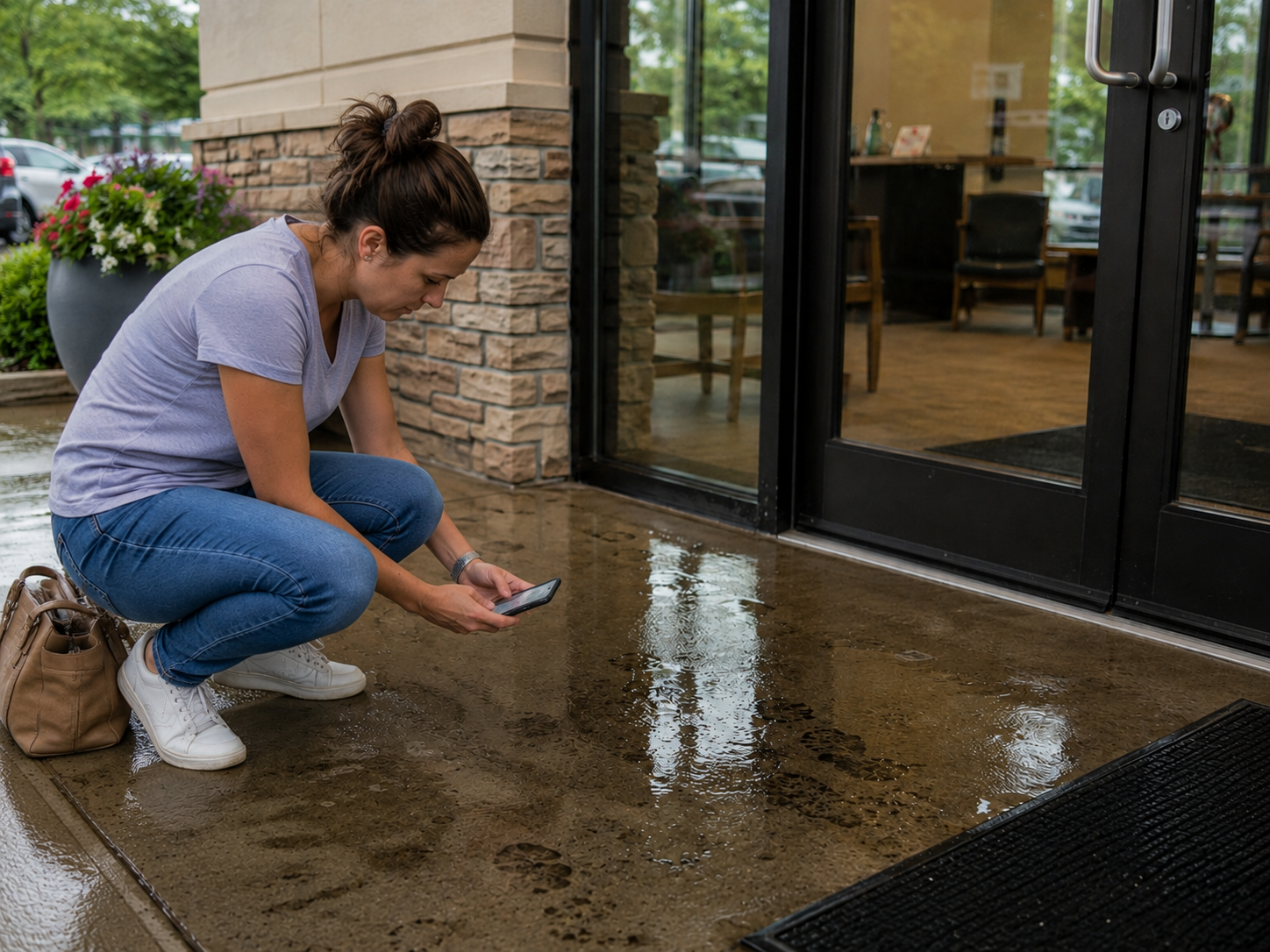
Photos of the hazard can help show what caused the fall. Pictures of wet floors, broken pavement, poor lighting, torn carpeting, uneven flooring, missing warning signs, or cluttered walkways may help explain what happened.
Incident reports can also matter. If you reported the fall to a manager, employee, landlord, business owner, or property representative, that report may help establish when and where the injury happened.
Medical records can connect your injuries to the fall. Prompt medical care can help document pain, diagnosis, treatment, restrictions, and how the injury affected your ability to work or handle daily activities.
Property records may also matter. In some cases, inspection schedules, cleaning logs, maintenance records, repair history, prior complaints, or employee policies can help show whether the property was reasonably monitored.
Even your own memory can be important. What did you feel under your foot? Was the floor wet, sticky, uneven, or poorly lit? Did your clothes become wet or dirty? Were there shopping carts, boxes, cords, mats, or other objects nearby? Did anyone clean the area immediately after your fall?
A slip and fall injury claim is often built by gathering these details before they disappear.
Why Acting Quickly Can Matter After a Slip and Fall
Time can work against an injured person after a fall. A spill can be mopped up. A floor mat can be moved. A broken item can be repaired. Surveillance footage, if it exists, can be overwritten. Employees may forget details. A store or property owner may also have records that are difficult to obtain or evaluate without legal help.
That is why it is important to act quickly.
If you are hurt, get medical care. Report the fall to the property owner or business. Take photos if you can do so safely. Save the shoes and clothing you were wearing. Write down what you remember. Keep receipts, appointment notes, work excuses, and any communication from the property owner or insurance company.
You should also avoid assuming that the property owner’s version of events is the final word. A business may say there is no video. A manager may say nobody else complained. An insurance company may say there is not enough proof. Those statements do not always answer the full legal question.
What if the Property Owner Says You Should Have Seen the Hazard?
In slip and fall cases, property owners and insurance companies may argue that the hazard was obvious, that you should have avoided it, or that you were not paying attention. That does not mean your claim is over.
The facts matter. A person walking through a store, parking lot, apartment building, workplace, or public-facing business is not usually focused on inspecting every inch of the ground. People look at shelves, signs, doors, vehicles, other customers, stairs, and where they are going. Some hazards are difficult to see until it is too late.
Lighting, contrast, weather, distractions created by the property layout, hidden defects, missing warning signs, and the location of the hazard can all matter.
That is one reason legal review can be important. An attorney can look beyond the simple question of whether you fell and examine what made the area unsafe, who was responsible for maintaining it, and whether the danger should have been corrected before someone got hurt.
How Dallas W. Hartman P.C. Can Help Build the Evidence
At Dallas W. Hartman P.C., we help injured people and families understand whether a slip and fall claim may still be possible, even when the evidence is not obvious at first.
When we review a premises liability case, we can look at where the fall happened, what condition caused it, whether the property owner had notice, what records may exist, and what steps should be taken to preserve evidence. We can also communicate with the insurance company, investigate the property, review medical records, and help determine whether the facts support a claim.
We know that a serious fall can affect far more than one day. You may be dealing with pain, medical appointments, missed work, transportation problems, and uncertainty about how long recovery will take. You should not have to sort through those questions alone while trying to figure out whether missing video or witnesses means you have no case.
Our Pennsylvania personal injury lawyers have represented injured people and families across Western Pennsylvania for decades, with offices in New Castle, Hermitage, Butler, Erie, and Pittsburgh. We take each case seriously because we understand that, for you, this is not just a claim. It is your health, your work, your family, and your future.
No Video or Witnesses Does Not Automatically Mean No Case
If you slipped and fell in Pennsylvania and there is no video or eyewitness, do not assume you have no options. The case may depend on other evidence, including the condition of the property, inspection practices, prior complaints, medical records, photos, and the timing of what happened.
Before you decide that your claim is too hard to prove, contact Dallas W. Hartman P.C. for a free consultation. We can review what happened, explain your options, and help you understand whether a Pennsylvania slip and fall claim may still be worth pursuing.
You pay no attorney’s fees unless we recover compensation for you.
Reach out to Dallas W. Hartman P.C. today to speak with our Pittsburgh personal injury lawyers, or use our online contact form to schedule a confidential case evaluation.
Disclaimer: The articles on this blog are for informative purposes only and are no substitute for legal advice or an attorney-client relationship. If you are seeking legal advice, please contact our law firm directly.