


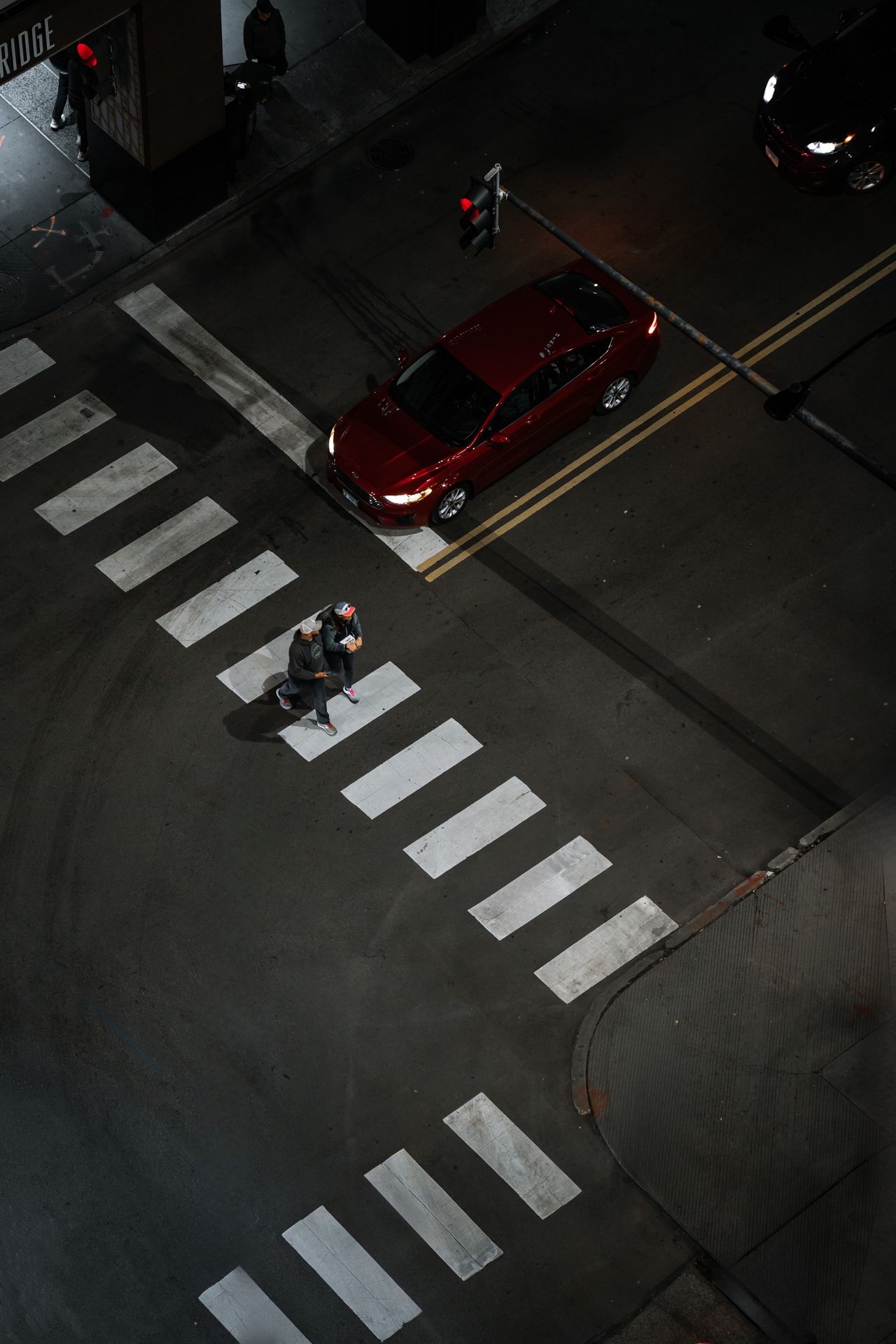
You are walking across a street after dinner, heading home from work, leaving a store, or walking along a road when a vehicle hits you.
Later, the driver says the same thing repeatedly:
“I never saw you.”
That can leave you wondering whether being hit after dark changes your rights, especially if you were wearing dark clothing, were not in a marked crosswalk, or were walking along a road without a sidewalk.
Those facts can matter. But a driver's statement that you were difficult to see does not, by itself, determine who was at fault.
After you’ve been hit by a car at night in Pennsylvania, determining fault requires looking at where you were walking, what the driver could reasonably see, how the vehicle was being operated, and what happened in the moments before impact.
Does a Driver Have to Yield to a Pedestrian in Pennsylvania?
It depends on where and how the pedestrian is crossing.
When traffic-control signals are not in place or operating, Pennsylvania law generally requires drivers to yield to pedestrians crossing within a marked crosswalk or an unmarked crosswalk at an intersection. The law also provides that a pedestrian must not suddenly step into the path of a vehicle that is so close that it creates a hazard.
Different rules apply when someone crosses outside a crosswalk. Pennsylvania law generally requires a pedestrian crossing elsewhere to yield to vehicles on the roadway.
Those rules matter, but no single fact automatically decides fault.
The investigation still has to look at what both the driver and the pedestrian were doing before the collision.
What If You Were Not in a Crosswalk?
This is one of the first things an injured pedestrian may worry about.
Being outside a crosswalk can affect the analysis because pedestrians generally have a duty to yield when crossing at locations other than a marked or unmarked crosswalk.
That does not automatically resolve the driver's responsibility.
A driver still has to operate the vehicle reasonably for the conditions and hazards present. Pennsylvania's safe-speed law requires drivers to use a reasonable and prudent speed based on actual and potential hazards and specifically calls for a safe and appropriate speed when special hazards involving pedestrians exist.
Suppose someone begins crossing a road outside a marked crosswalk and a driver has enough time and distance to see the person but continues at the same speed.
That situation raises different questions from one in which a pedestrian suddenly steps into traffic immediately in front of a moving vehicle.
The exact sequence matters.
What If the Driver Says They Could Not See You?
Poor visibility can be relevant, but it does not end the investigation.
A nighttime pedestrian case may require looking at exactly what the driver could see from the driver's seat.
- Was the street illuminated?
- Were there streetlights, storefronts, parking-lot lights, or headlights from other vehicles?
- Was the pedestrian visible for several seconds before impact?
- Was the driver turning?
- Was the windshield clear?
- Were the headlights functioning properly?
- Was the driver looking at the roadway?
- How fast was the vehicle moving?
Those questions are often more useful than simply asking whether the accident happened after sunset.
This can be especially important on roads in and around New Castle, Hermitage, Sharon, Butler, and other Western Pennsylvania communities where pedestrian routes may cross busy local roads such as Routes 18, 19, 224, or 422.
Does Wearing Dark Clothing Make a Pedestrian Responsible?
Not automatically.
Clothing can be one fact in a larger visibility analysis, but it should not be treated as the entire case.
An investigation may need to examine lighting, sight distance, the location of the pedestrian, the direction of travel, the driver's speed, headlight illumination, nearby traffic, and whether the driver was distracted.
A reconstruction or scene inspection can sometimes help evaluate when and from what distance a pedestrian may have become visible under similar conditions.
That is much more informative than an after-the-fact statement that the pedestrian was “hard to see.”
What Evidence Can Show What Happened?
Nighttime pedestrian accidents often involve conflicting accounts.
The injured person may remember entering the roadway and seeing a vehicle farther away. The driver may insist the pedestrian appeared suddenly.
Independent evidence can help test those versions.
Depending on where the crash occurred, that evidence may include:
- Surveillance footage from nearby businesses or homes
- Traffic-camera or intersection footage where available
- Photographs of lighting and roadway conditions
- Vehicle damage
- Witness accounts
- The driver's cellphone records when distraction is legitimately at issue
- Event data from the vehicle
- Police measurements or observations
- The timing and sequence of nearby traffic signals
Some of this evidence can disappear quickly.
Businesses overwrite video. Lighting conditions change. Vehicles are repaired. Witnesses become harder to locate.
That is why an early investigation can matter.
At Dallas W. Hartman P.C., we can help identify what evidence may still be available and compare it with the different accounts of what happened to better understand how the crash occurred.
What If the Driver Says You Were Partly at Fault?
Pennsylvania allows responsibility to be divided when more than one person's negligence contributed to an injury.
Under Pennsylvania's comparative-negligence rule, an injured person can still recover damages when their share of negligence is not greater than the negligence attributed to the defendant or defendants, although the amount recovered is reduced by the injured person's percentage of fault.
For a pedestrian, that means crossing location, traffic signals, visibility, and timing can all matter.
The driver's conduct matters too.
A claim that you were partly at fault is not the same as a final determination of responsibility. The evidence still has to be examined before fault can be meaningfully evaluated.
What If You Were Walking Along the Road Rather Than Crossing It?
Pennsylvania law also addresses where pedestrians should walk when sidewalks are or are not available.
Where a sidewalk is available and practical to use, Pennsylvania law generally requires pedestrians to use it rather than walk along the adjacent roadway. Where there is no sidewalk, pedestrians walking along the highway generally must use the shoulder as far from the roadway as practicable. If neither a sidewalk nor shoulder is available, a pedestrian generally must walk as near as practicable to the outside edge of the road and, on a two-way roadway, on the left side.
Pennsylvania law also generally requires pedestrians who are walking on a roadway to yield to vehicles, unless another pedestrian right-of-way rule applies.
Those rules can matter in nighttime crashes involving people walking home, exercising, or traveling along rural or suburban roads.
But the analysis does not stop with whether one pedestrian rule was followed.
Fault still depends on the full sequence of events, including where the pedestrian was walking, what the driver could see, and how both people acted before the collision.
Hit by a Vehicle After Dark in Western Pennsylvania?
If you were struck while walking at night, questions about visibility, clothing, crosswalks, or where you were walking do not necessarily tell the whole story.
At Dallas W. Hartman P.C., we can review the roadway, lighting, available video, witness accounts, vehicle evidence, and Pennsylvania traffic rules to help determine what the evidence shows about how the crash happened and who may bear responsibility.
From our New Castle office and locations throughout Western Pennsylvania, we represent pedestrians who have been seriously injured in vehicle crashes.
If you have questions about what happened, you can use our contact form to speak with our team about the evidence, the circumstances surrounding the collision, and what legal options may be available.
Disclaimer: The articles on this blog are for informational purposes only and are no substitute for legal advice or an attorney-client relationship. If you are seeking legal advice, please contact our law firm directly.